There’s understandably a persistent worry that as AI becomes more sophisticated, the human actor will eventually become a relic of the past. It’s a fear as old as the first "talkie," yet it overlooks a fundamental truth: technology doesn't replace the need for human connection; it simply changes the stage upon which that connection happens.
There will be a lot of shifting and some pain in the industry, but it's mostly going to be about re-organising things, and it's not going to be as impactful as one might believe. Here I will argue that not only will actors be mostly unaffected: we're probably going to need more of them.
Actors aren't going to be disappearing any more than dancers did when film was invented. In fact, we are entering an era where the human performer will be the most sought-after "special effect" in a director's toolkit.
The Jurassic Park Standard: Acting with the Invisible
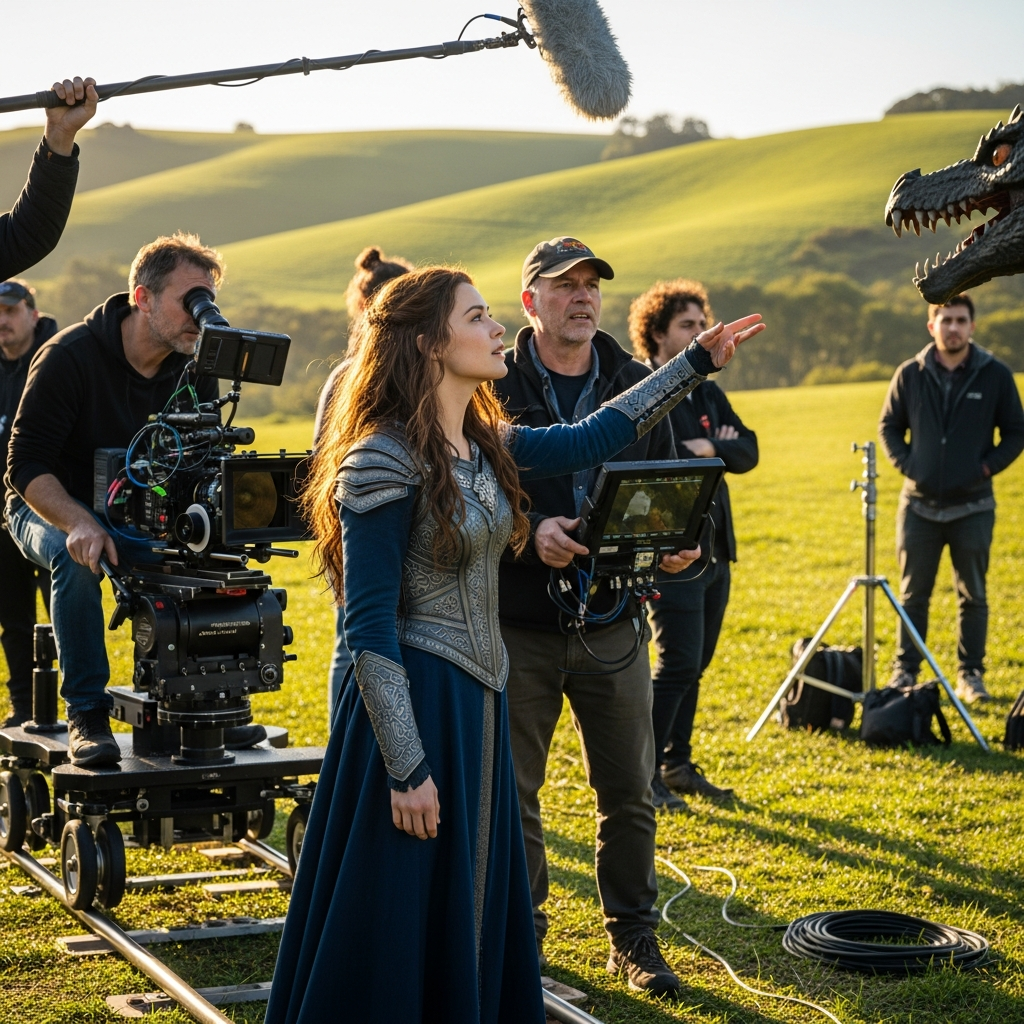
To understand the future, we have to look back at the pioneers. When Laura Dern, Sam Neill, and Richard Attenborough filmed the iconic Brachiosaurus reveal in Jurassic Park, they weren't looking at a majestic creature. They were looking at thin air, a piece of tape, or a director shouting cues from a megaphone.
Laura Dern has admitted that in those early scenes, she wasn't sure the movie would even work. But it worked because of her. It worked because she and her co-stars projected a sense of wonder and terror so authentic that the audience stopped seeing pixels and started seeing life.
AI is good enough to emulate that now, but it doesn't matter. First of all, the human connection and the psychology of watching human actors emulate emotions on cue is why stage actors moved onto film in the first place. The bottom line is that no matter how good the AI generative video models get - and they're already easily good enough - human actors are going to be a going concern. In fact as I will argue in a moment: we're going to need more of them due to the democratisation of filmmaking (which outcome is not a bad thing and doesn't necessarily mean lower quality).
Secondly, although AI can replace the core functions of actors, there are things it can't do and will likely never be good at, and moreover: human actors can do a number of things much faster. Emotional authenticity is also still a competition that human actors usually win. Even when they don't it's important to realise that they can produce it faster and that - crucially - takes 2, 3, and 4 with an actor are cheaper and faster than with most frontier AI video models.
Thirdly, there are other important psychological dynamics supporting the perpetuation of the acting profession. Things which may not seem obvious at first. The audience is also consuming the interplay between human actors. People don't just love seeing Bogie and McCall or Gosling and Stone, they love seeing Gosling with Stone. Adjunctly, this matters for quality of life of every artist from the director to the rest of the cast and crew. Working with people is never easy, but never teaming up to make art is positively unhealthy according to psychological science. Isolation is not very healthy, and AI does not fix it.
As directors move toward using AI to generate complex creatures or even digital scene partners, the demand for actors who can "believe" into the void will skyrocket. It takes a master craftsperson to maintain a grounded, emotional performance while interacting with something that isn't physically there. Directors working with high-tech tools need human anchors to make the impossible feel real.
The Democratization of Cinema: More Films, More Roles
One of the most exciting aspects of the AI revolution is the democratization of filmmaking. For over a century, making a movie required millions of dollars and a literal army of technicians. Today, AI tools are lowering the barrier to entry, putting high-end production value into the hands of independent creators and visionary directors who previously lacked the budget.
We are about to see an explosion in the sheer volume of films being produced. Think of it like this:
The Printing Press Effect: Just as the printing press didn't kill storytellers but created more authors, AI will create more directors.
A Growing Ecosystem: Even if a single film uses fewer human actors (perhaps augmenting the cast with digital extras or AI-driven creatures), the total number of films being made is set to multiply.
Net Gain for Talent: More directors means more stories, more scripts, and more opportunities. A hundred independent films needing two lead actors creates more work than one massive blockbuster needing twenty.
The Irreplaceable Human Element
At the end of the day, audiences don't go to the movies to see perfect pixels; they go to see themselves reflected in the eyes of another human being.
We crave the "glitches" of humanity—the slight tremble in a voice, the micro-expression of doubt, the way an actor breathes. These are the things AI emulates but that humans do as humans. As filmmaking becomes more accessible to the masses, the actors who can bridge the gap between digital marvels and the human soul will be the true stars of this new frontier. Since that kind of skill set is core in all acting training and classes, actors are going to be more than okay.
I am wondering when the first movie made entirely by a professional actor using something like NeuraScene.app will happen?
The Four Day Working Week and UBI
Some business moguls and politicians are already seriously both discussing and implementing shorter working weeks and talking seriously about universal basic income.
What does that have to do with the currency of actors?
As more people prospectively have more time on their hands, the entertainment industry is likely to get a serious boost.
That's provided the transition to an AI and robot based Western society and economy is managed well and the world doesn't experience a tragic great depression and/or some kind or violent revolution due to it.
Fingers crossed. The AI is here to help us get it right. That's a bonus which might make all of difference. It should, given the track record of AI so far. (e.g. AlphaFold.)
The stage isn't shrinking—it's expanding. And there's a spotlight waiting for those ready to step into the light, even if they're talking to thin air.
"It’s the actors who make the dinosaurs real. Without their awe, it's just a puppet show."


