Metaphysics of Models

8/2/2026
1 min read
By Bruce R. Long

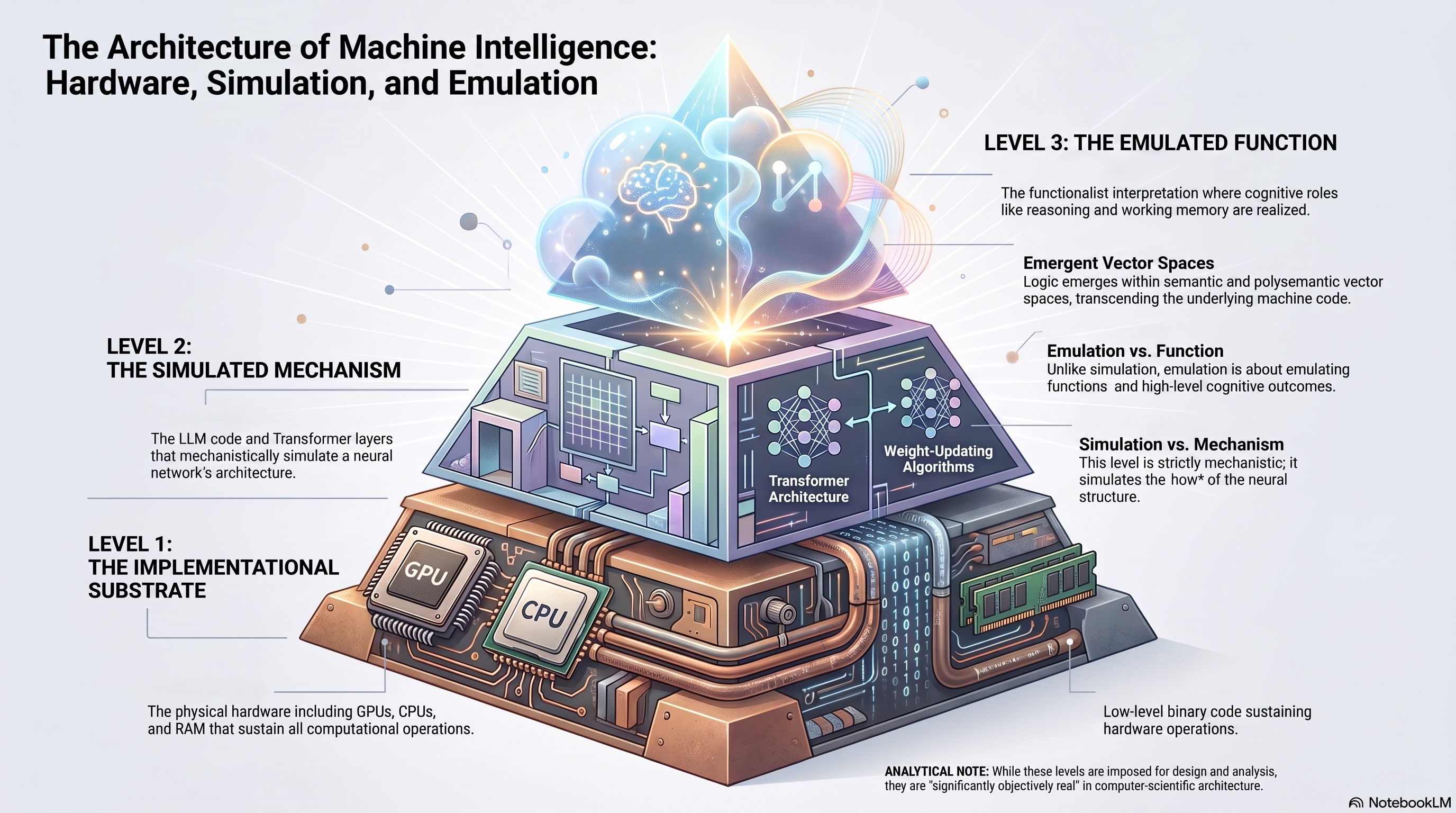
My third year Ethics and AI students are a mixed bunch (philosophy, law, psychology, teaching, literature, business, cyber security). It's a philosophy, ethics, and philosophy of information course, and so the idea is to use analytic philosophy, formal and philosophical logic, and normative ethical concepts and theories to ask the right questions and formulate solutions for AI-related ethical problems. One of the challenges is characterisation of the nature of transformers and their functions. I use a mix of the method of levels of abstraction, mechanistic philosophy, and functionalist philosophy of science. This presentation really helps the students.

1. Hardware: the physical 'layer' and its programmatic elements.
2. Simulation of Mechanism: The LLMs and their architecture simulating the brain's neural networks (Mechanistic interpretation.)
3. Emulation of Function: The semantic and polysemantic (multimodal) vector spaces and their concept mappings, emergent logic in induction heads, and emergent reasoning linked to linear concept vectors.
Continue Reading

Agency News
The Virtue Credit: Why 'Important' Campaigns Underconvert

The Virtue Credit: Why 'Important' Campaigns Underconvert

When a launch asks an audience to feel good about caring before asking them to buy a ticket, it pays their moral tab in advance. When a studio or streamer launches a prestige drama, a hard-hitting documentary, or a…

The Disjunctive Cut: Staging the Ignored Expert

The Disjunctive Cut: Staging the Ignored Expert

Why ensemble breakthroughs fail on screen, and how to block the exact boundary between group incompetence and synergy. The War-Room Cliché In almost every ensemble thriller, investigation series, or crisis drama, there…

The Resting Baseline: Blocking Unprovoked Tension

The Resting Baseline: Blocking Unprovoked Tension

Why the most revealing beat in a thriller isn't how a character reacts to a threat, but how their body fires when nothing happens at all. When a second act sags, the instinct in the writers' room is to add an external…

The Single-Payoff Rule: Stripping Motive Ambiguity

The Single-Payoff Rule: Stripping Motive Ambiguity

Why giving a character three good reasons to make a choice leaves the audience guessing who they actually are. When an Act One turn fails to land in a test screening, the notes almost always diagnose a weak motive. The…

The Five-Degree Penalty in Key Art

Why primary visual cortex orientation tuning punishes approximate blocking in theatrical posters and trailers. The Cost of an Approximate Angle When a theatrical poster or streaming thumbnail fails to arrest a scrolling…

The Task and The Team

The Task and The Team

Your message has to persuade two different mindsets: the one focused on the goal, and the one focused on the group. The Split Decision That Kills the Deal You’ve seen it happen. The presentation for your new…


Discussion

(0)

Join the discussion

Sign in to comment